
Chapter 22 - The Syrians
And a note

Note - This is a draft. Comments, suggestions, and criticisms are more than welcome and would be greatly appreciated. Thank you to those who have done this on other chapters. Your input is very valuable. Have an awesome day. Rhino UP!!
Chapter 22
Lamplight. His old cell. Jasmine.
Leila beside him. Her shoulder against his. Fingers in his hair. Slow. Patient. The way she always did.
Humming. That melody about cherry trees. Blossoms falling like snow.
He closed his eyes. Let the warmth fill him.
Her hand stopped.
He opened his eyes.
She was looking at him. Face strange. Distant.
The cell was gone.
Sand. Sun. The roar of a crowd.
The pit. The trident in his hand. Heavy. Warm from his grip.
Leila stood where the crowd should be. Alone. Watching.
The trident already flying.
He saw it leave his hand. The arc. The spin. Three iron points catching light.
The boy.
Standing where he shouldn’t be. Soft face. Wide eyes. Mahmud’s hand still reaching for his shoulder.
The trident hit.
The sound. Wet. Final. The boy’s hands coming up. Finding the shaft. Confusion.
His eyes finding Asad’s.
Then Leila’s.
She watched. Face unchanged. Just watched the boy slide down the post. Watched the blood pool beneath him. Watched Asad standing there with empty hands.
Her lips moved.
No sound. Just shapes. Words he couldn’t hear.
He tried to step toward her. Couldn’t move. Tried to speak. No voice.
She kept looking at him. Through him. Into the place where the animal lived.
Her eyes. Worse than anger.
Sad.
He woke.
Canvas. Grey light.
Chest heaving. Sweat cold on his skin. His hand gripping the kilij. Gripping it hard enough to ache.
Leila’s face dissolving. But her eyes stayed.
Asad sat up. Heels of his hands pressed to his eyes.
Killed men. Dozens. Their faces blurred together. Anonymous meat. Opponents. Obstacles.
This one stayed.
Leila would have seen.
The meaning. She’d seen the man beneath the lion. The human she’d touched and fed and loved.
What would she see now?
He buried the thought. Forced it down where it couldn’t breathe.
The boy was Mahmud’s blood. Would have grown into another master. Another man who kept people in cages.
Had to be.
He lay back.
Hollow.
Simeon came at dawn.
“They’re waiting. The others.”
Asad rose. Body moved easier now. Food. Agnes’s work.
He followed Simeon through the camp. Past cookfires and drilling soldiers. Past horses being brushed and armor being hammered.
They stopped at a cluster of smaller tents near the supply wagons. Away from the main force.
Men sat around a cold firepit. Eight of them. Dark hair. Olive skin. Features that belonged to the land east of here.
They looked up as Asad approached.
Simeon spoke in Arabic. “This is Asad. The one I told you about.”
Silence. Eyes moving over him. The scars. The pale skin. The way he stood.
One of them, young, barely twenty, thin face, laughed. Short and sharp.
“The pit fighter. The one who shreds dummies and makes the Norman knights nervous.”
“Fadi.” Older man. Thick beard going grey. “Manners.”
“What? It’s what they’re saying.” Fadi shrugged. “White Lion. Kills men for sport. Now he’s going to teach Franks how to swing swords.”
Asad waited. Let them look.
The older one stood. Extended his hand.
“Karam. From near Antioch. Originally.”
Asad took the hand. Firm grip. Callused. A man who’d worked.
“Sit. We have bread. Probably stale. But bread.”
They made room. Asad sat.
Fadi passed him a chunk of flatbread. Hard at the edges. He took it.
Eight men. Different ages. Different builds. But the same look in their eyes. People who’d lost something.
“Simeon says you were a slave,” Karam said.
“Yes.”
“Turkish master?”
“Yes.”
Karam nodded. The others exchanged glances.
“Then you know,” Fadi said. “What they are.”
Asad chewed the bread. Said nothing.
“We know too,” Karam said. “Different knowing. But knowing.”
The silence stretched. Comfortable. These men didn’t need words to fill space.
“Simeon said you’d tell me,” Asad said. “The situation. From your eyes.”
Karam looked at the others. Something passed between them.
“What do you want to know?”
“Why you’re here. What happened.”
Fadi laughed. Bitter. “How much time do you have?”
“Enough.”
Karam settled back. His voice distant now.
“I’ll tell you mine. Then you’ll understand theirs.”
“My family, we worked olives.”
He says it like a fact. Like something carved into a stone that has since been broken.
“My father, his father, his father. The trees were older than our name. Old gnarled things reaching for the sun. You could taste the oil in the air before you saw the grove. It got in our skin. Our clothes. That smell was home.”
He looks at his hands. They are empty now. Callused, but clean.
“We were Christians. The church was made of stone from our own fields. My ancestors built it, stone by stone. The bell, you could hear it for miles. Every Sunday. For births. For deaths. Sometimes for no reason at all, just to hear it sing. I rang it when my son was born. Elias.”
He stops. His throat works. There is a hole in the story here, and he steps around it carefully.
“The Muslims were there before my father’s time. They said we could stay, worship our god, if we paid. So we paid. We paid for the right to exist on land our blood had fertilized for a hundred years. The jizya. Then the zakat. Then a tax for having a roof, a tax for having a well, a tax for the air our children breathed. We paid. We became experts in paying. My wife buried coins in a clay pot beneath the hearth. Always saving for taxes. Another man, another scroll, another reason we owed more.
“The Turks, they were different. They didn’t want taxes. They wanted everything. First they took our livestock. I can still hear our goats, the sound when they drove them off. My daughter, she cried for three days over a kid she’d named. Then they took the grain. That winter we had nothing. We were weak, all of us. My mother, she caught a fever and her body had nothing left to fight it. Two months she lingered before she died.”
He closes his eyes for a moment. Opens them.
“Every Sunday we would say it. As we forgive those who trespass against us.” He pauses. “I have not forgiven.”
Asad heard the words. Forgive. The concept had no shape in his mind. No place to land.
“Then they silenced the bell. Said its song was an insult. A noise that had marked our joys and griefs for two centuries, they declared an offense. The silence that followed, it was the loudest thing I have ever heard.”
“Last spring, they came for my son. Elias. Fourteen years old. He had my father’s smile. He was learning the trees, could tell an olive’s ripeness by the shade of its skin.”
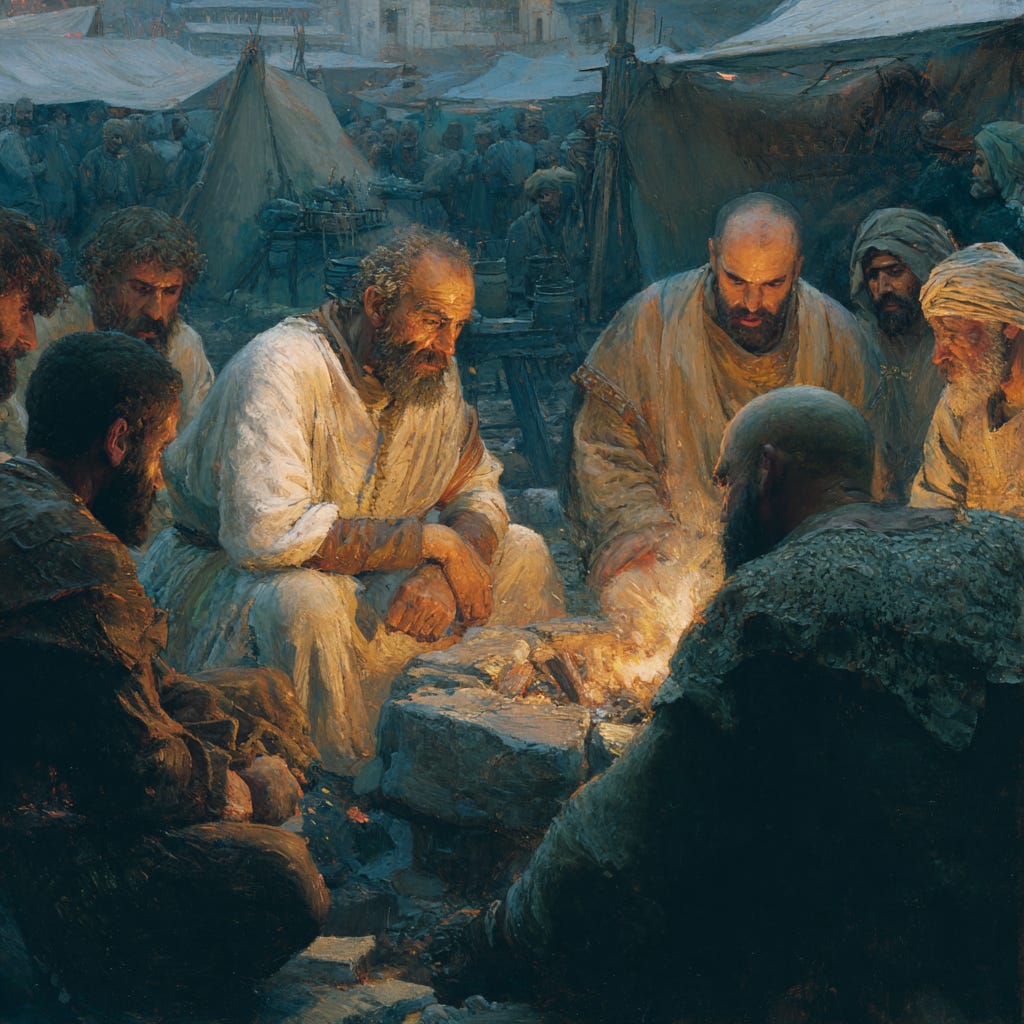
Spity when he talks now. “They did not take him in battle. He was not a soldier. They pulled him from our table. His supper was still on his plate. They put him in a line with other boys. Like sorting fruit, you understand? When I tried to stop them, they held a sword to my daughter’s throat and I lost my will to fight. They marched him down the road and I just stood there. Watching. Father. Deliver us from evil.”
The men around the fire are stone. They have heard this. They have lived this. It doesn’t get easier.
“Pilgrims came through our village every year, on their way to Jerusalem. They always had. But over the years, they started arriving in worse and worse condition. Beaten, robbed, some of them barely alive. The women, there are things you don’t speak about. They’d stop with us, rest, and they’d tell us what was happening on the roads. The Turks weren’t just taking payment anymore. They were taking everything. Sometimes we’d find pilgrims dead in the ditches, and we’d bury them in our cemetery. After a while, fewer and fewer came through. Eventually they stopped coming at all.”
Turns to Asad. Veins standing out in his neck.
“They desecrated our church. Shattered the icon of the Virgin my great-grandmother painted. Used the altar stone to sharpen their blades. Father Yohannes, he tried to stop them. We found him in the ditch beside the road. His hands were still folded in prayer. They had broken every finger.”
He says this last part softly. A sacred horror.
“We prayed for God to deliver us from this evil. When we heard of the armies from the north coming, we knew it was time. Time to fight this satanic menace. We gathered what we could carry and left. Left everything behind with the hope of helping God’s army rid the world of this evil. We are taught vengeance belongs to the Lord. We are His tools now.”
He gestures to the grim faces around him, then toward the edge of camp where the non-combatants huddle.
“They hunted us from Antioch to here. The people you see, we are the remnant. The ones who were fast enough, or lucky enough, or who had nothing left for them to take.”
The silence lasted a long time.
Asad sat with it.
Mahmud’s cruelty. The cage. The pit. Leila. His mother screaming while they dragged him away.
What Mahmud did to him, a thousand Mahmuds did to a thousand villages. Sons put in lines and marched away. Daughters sent down dangerous roads. Wives buried under trees.
And these men. They’d lost what he never had. Homes. Families. Olives in summer. A bell on Sunday morning.
He had no home. No village. No god to pray to.
A woman’s throat opening. A boy pinned to a post.
Karam lost a son. Ready to fight those who took him. Kill them.
Asad killed one. To wound a father. He’d grinned at the pain in Mahmud’s face.
The thought sat heavy.
Leila’s eyes. Watching.
Would she still see a man?
“You’re quiet,” Fadi said.
Asad looked up.
“Most people say something after Karam’s story. God’s will. Justice coming. The Franks saving us.” Fadi’s smile was thin. “You just sit there.”
“I have no words.”
Fadi studied him. The smile faded.
“No. I don’t think you do.”
Karam looked at Asad. “Tell us yours.”
Asad rose.
I like this, but… use AI to shred it and re edit then modify and reiterate. You need to tell the AI to find every inconsistency and logical leap /shorthand gap and then fix them. The do it again. Most things I wrote now have three to four revisions. Your flashbacks need a better transition and consider t he risk of waking a man like that particularly if he is armed
"There is a hole in the story here, and he steps around it carefully."
Brilliant. It feels like... There's a line in "The Fountainhead":
"Roark knew that Wynand seldom spoke of his childhood, by the quality of his words; they were bright and hesitant, untarnished by usage, like coins that had not passed through many hands."
That's how those words felt, like bright coins untarnished by usage.
Is this a pivotal chapter? We begin to see signs of regret, perhaps the dawning of what might become repentance, though it comes through the dream of disapproval of a former lover. Asad starts to wonder if the love of his life, Leila, might not approve of his killing the son of his slave-master.
IIRC, Asad himself was a little shocked by what he did because he saw the face of the boy as he died. And he starts to realise that, although he did it to hurt the slave-master Mahmud, he took an innocent life, albeit a life that was probably being groomed to become another cruel slave-master, but, Asad is starting to ask himself if that excuse actually hold up to scrutiny.
There's a lot going on here, under the surface of the men's staccato words. Karams's story opens a parralel: the loss of his son that Karam's suffered is what Aad inflicted on another man. "But he was a bad man, so that's ok!" If Asad doesn't buy that excuse, it'll get really interesting.
OK, now for the bad news: "Spity when he talks now." What is this "spity" of which you speak??