
Unrepentant - Origin
Inspired by the movie Unforgiven

Legend has it that Billy Easton vanished into thin air, never to be seen again, after taking down eight men single-handedly in the Lucky Star saloon, the very establishment that had seen fit to use his friend’s hanging body as a decorative warning to would-be assassins. I write this as witness to that event, and after a tedious amount of travel and research, I have learned a great deal about the man who walked out into the thunderstorm alone. Two dozen armed men peppered throughout the thoroughfare. All of them terrified of the man, the reputation, and the likelihood of becoming one of the pile of bodies that trailed him wherever he went.
Billy raised his arm against the first of the morning sun that hit him, a light just bright enough to make a man squint. The smoke from the red coals filled his nose. He pulled the bedroll tighter against the cold air off the river and lay still as the woods came alive around him. A squirrel worked the branches of the oak above him, indifferent to the man below.
He sat up and reached for his boots. Behind him the mule shifted and blew. The dressed meat and the cool hide of the mule on the morning air. He laced his boots and stood and checked the panniers. The mushrooms were still wrapped tight in the burlap, a fat sack of them. He chuckled at how Nora’s cheeks filled with fire when she kissed him that first time he brought her mushrooms. Mrs. Hatch giggled from across the room. Mr. Hatch found something useful to do.
He broke camp, rolling the bedroll the way his father had shown him before he was old enough to do much else, checking the mule’s load and the horse’s shoes before he mounted. Several mushrooms fell out of the sack that had come loose and rolled against the mule’s flank. He picked them up. His hands were clumsy from the cold and several slipped through his fingers. He swore and laughed at himself. Clara would have laughed at him. Three deer dressed and salted. Pelts enough to trade. The mushrooms for Nora. A hawk feather he’d found on the third day. Thomas ain’t gonna shut up about it for weeks. He stepped up into the saddle and turned south toward Harlo.
He stopped whistling.
The smell came on the wind out of the south and he did not recognize it, but his hand found the reins and the horse slowed without being asked. He sat in the October timber and let it come to him. Woodsmoke. But under it an odor that woodsmoke doesn’t make.
No.
He put his heels to the horse.
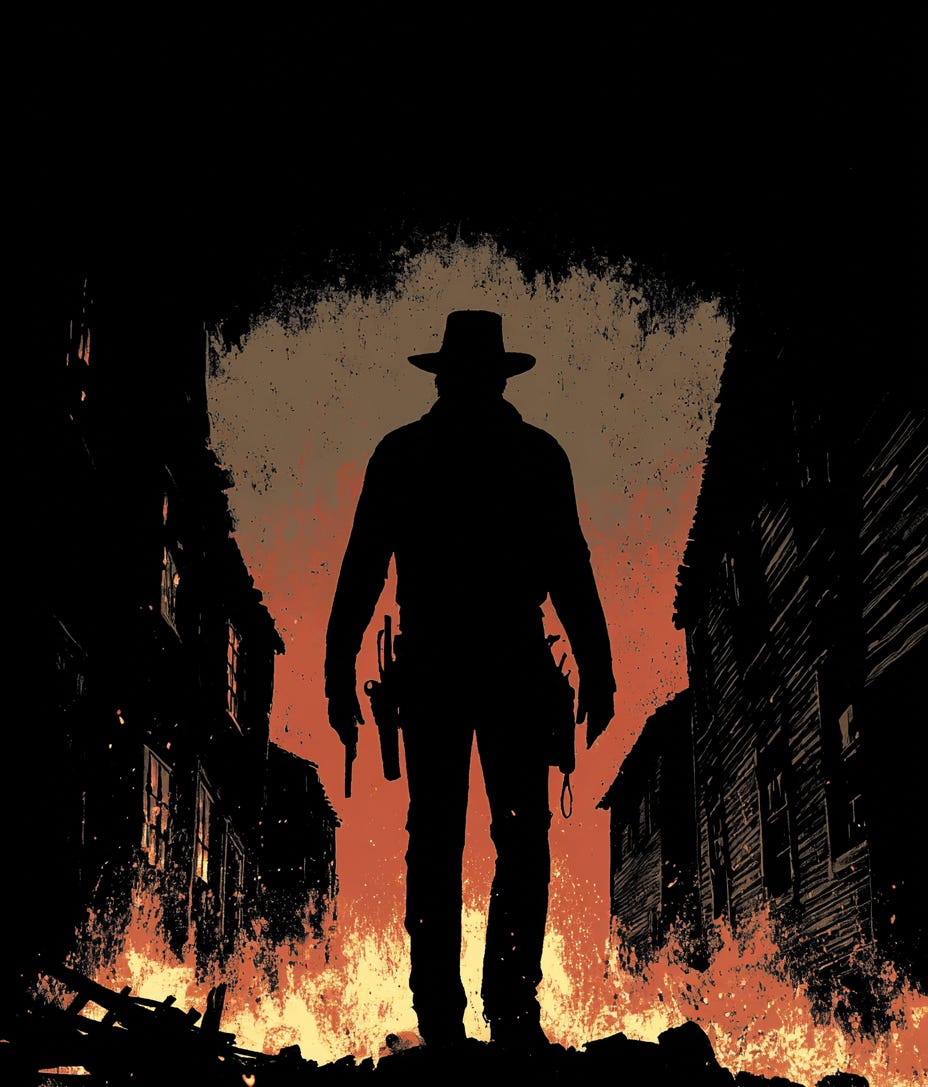
He came through the tree line at a dead run and saw the black column rising against the sky and he was screaming before he cleared the timber, screaming his father’s name and Clara’s name and Thomas’s, the horse running flat and hard down the south road until he hit Harlo from the north end and pulled back so hard the horse reared and came down sideways in the road.
He sat on the horse and did not move.
The livery gone. The general store gone. His father’s office on three walls with the roof caved in. The church at the south end burned to a single standing wall with the cross still on it. The cruelest thing he had ever seen. George Hatch face down in front of the tannery. Reverend Moore in the doorway of the church. Cal Briggs in the road.
Then he saw Clara.
He was off the horse and running toward the body. He knew it was her and wouldn’t let himself believe it. He slid on his knees beside her in the dirt of the thoroughfare. Her dress was torn up around her waist and she had been cut open from her chest to her belly and the blood around her in the road had dried black in the dirt. He pulled her dress down and held her head in his hands, his tears falling on her face. He cleaned the dirt and blood and dried tobacco spit off of her face. Her green eyes were open and still. Sixteen years old with a laugh that could fill a room and he could almost hear her laughing at him. Get up, clumsy. He put her hair back from her face and held her and did not move.
The sun had moved higher when Billy looked up and the world spun once before it held. The smell of the dead was everywhere, sweet and thick on the still air. A crow dropped out of the sky and landed on George Hatch twenty feet away. Billy pulled his pistol and fired and missed wide. The crow lifted off without hurry and settled on the roof beam of the burned livery and looked at him. He holstered the pistol, laid his sister’s head gently on the ground, and stood.
The Hatch house sat at the end of the thoroughfare. He made himself walk toward it.
He gagged when he pushed the door open. Rotten and rank. A few flies lifted off the dead man in the corner and settled again. His mother was near the overturned table, her housedress torn from her shoulder, her face turned to the wall. He read the room the way his father had taught him to read a wood line. The chair on its side. The broken crockery. Her fingernails. The dead man in the corner with her kitchen knife in his chest and the look on his face that said it had not gone the way he planned. Billy stood over him a moment. He did not move the knife. Then he sat down on the floor beside his mother and for a moment he could smell biscuits and gravy. His mind went to her at the stove on a cold morning, her humming something he could never name. He was still weeping when he stood. He did not remember crossing the room to Thomas.
Thomas was in the back room. Curled on his side, shot once in the head. The slingshot Billy made him lay a few inches from his extended hand. He was twelve years old and he still had the gap in his teeth. Billy sat on the edge of the bed and picked up the slingshot. He turned it in his hands. He thought about the morning Thomas brought down his first dove with it and the smile on his face that night when Ruth set it on the table in front of him. That smile.
He did not know how long he sat there. Long enough that the light through the window changed. He drove his fist into the wall. The wood was hard. His knuckles split. He hit it again and stood there with his hand bleeding and felt nothing. He gently set the slingshot back in Thomas’s open hand. Then he stood and walked out through the house and into the thoroughfare. He did not look back.
He crossed to his father’s office. Three walls under open sky. He stepped through the doorframe into the smell of cold char. His father’s chair was still behind the desk. He turned away and spit. His back teeth were grinding. He wondered how long.
He found his father under a fallen rafter near the back wall. He’d been shot once through the forehead. His face was turned up toward the October sky. His star still on his chest. Billy went to one knee beside him and stayed there. He reached down and took the gun from his father’s hand. The grip was scorched on one side. He stowed it in his belt. He could hear his father’s voice. Ten years old in this same office, his father’s hands covering his on the grip.
That’s a Colt Navy. You treat a gun like that right, it’ll never let you down. Same goes for people, boy. You’ll know the ones worth keeping. This’ll help you with the ones who ain’t.
When he rose, he wore the face he would carry the rest of his life. A face that could terrify people at a glance. He wouldn’t know it for years, but the men he rode with would.
He picked up the bottle and drank. It came back up before he was ready and he bent and heaved so hard the soot rose in a low cloud around his boots. He stood and spit. The throat on him was a furnace. He was pulling his next breath when he heard it.
“Help.” What came out of him was more air than voice. “Please. Help me.”
Billy wiped his mouth and had his gun up before he cleared the doorway.
He came around the east wall slow. A man lay in the rubble at the base of the collapsed wall, pinned under a beam, one arm stretched out in the cinders. He was Black. His shirt was gone on one side. The skin from his wrist to his elbow was red and swollen and tight with blisters, slick where they’d burst. The gash across his forehead had bled down his face and dried there. His lips were cracked white. When his eyes found the gun, they were the eyes of a man who had been in that spot since before the sun came up.
Billy looked at him over the barrel for a long moment.
“Watah. Please sir. Watah. In my satchel right dere. Please sir.”
He lowered the gun.
“Who are you,” Billy said.
“Please sir. De satchel. Watah.”
Billy found the satchel in the rubble and pulled out the water skin and held it for him. Amos drank a long time. Then Billy pulled it back.
“Who are you,” Billy said.
“Amos Greer. I wuz in de sheriff’s jail.”
“Why were you in my father’s jail. What didja do.”
“Mo’ watah. Please sir.”
Billy tilted the skin and let it run into his mouth and pulled it back.
“Talk,” Billy said.
“I wuz stealin’ food. Behind de sto’.” Amos stopped to breathe. “Yo’ daddy find me. Coulda turn me in. Runaway. He don’t do dat. He feed me. Kep’ me in de jail so de townfolk don’t git riled.” He paused. “Say I could stay till I got my strength. I wuz weak from de road. Been runnin’ wit’ some wild ones. Bad mens. Left dem a few days ride befo’ I got heerah.”
He stopped. “Watah. Please. Billy. Jus’ a li’l mo’ watah.” Billy tilted the skin and let it run into his mouth.
The man had said his name.
Amos closed his eyes a moment and continued. “We talk a bit. He tol’ me ‘bout you. How you wuz out gettin’ food fo’ de wintah.” He looked at Billy. Eyes sunken and pink. “Can you help me git out from undah dis, boss. I ain’ gonna do no harm. I swears it.”
Billy got his hands under the beam and lifted. The wood was heavy and did not move at first. He got his legs under him and drove upward. A hot spike went low in his back and the beam rose an inch and then another. His knuckles split open again against the splintered edge of the beam.
Amos pulled himself free with his good arm, his legs dragging behind him, slow and useless, and Billy let the beam drop. It hit the rubble and sent up a low cloud of soot.
Amos reached for the water skin before he tried to sit.
He tried to sit up and the sound that came out of him was more animal than human. The blood was coming back into his legs. He curled over his knees with both arms wrapped around himself and rode it out.
Billy winced when the smell of urine reached him.
When it passed he lay back breathing hard. Billy took what was left of Amos’s shirt and wrapped the arm. Amos’s breath came fast and shallow while Billy worked but he did not pull away. Billy tied it off and stepped back.
Billy got the satchel and set it beside him. Amos’s good hand went into it and came out with a biscuit wrapped in cloth.
Billy looked at it.
It was his mother’s cloth. He knew the pattern. The biscuit was his mother’s biscuit. The shape of it. The color.
He grabbed a length of burned timber and swung it into the wall. Again. Again. He kept swinging until the timber split in his hands and he stood there breathing.
Amos pressed himself back into the rubble and did not move.
“Who did this.”
Billy picked up the bottle and took a swig. Smaller this time, the reflex that was there before gone now.
Amos ate slowly. His hands had stopped shaking as bad.
Billy was on his feet. He moved along the edge of the rubble, bottle in hand.
“Two days ago,” Amos said. “Mornin’. Word had got around dat a runaway wuz bein’ held in de jail.” He watched Billy move. “Wade Colby. Five men wit’ him. Rode in slow. Like dey owned de street.”
Billy took a drink and kept moving.
“Colby rode up to de office and screamed. Sheriiiff. Give us de nigger. Yo’ daddy come out. Colby said it again. Sheriff, give us de nigger rapist we know you holdin’.”
Amos shook his head.
“I swears I nevah done dat. I swears it on my life.”
Billy said nothing.
“Yo’ daddy looked at him. Took his time wit’ it. Den he said no.” Amos looked at the spot in the road. “Just dat one word. No. Right dere in front of everybody.” He paused. “Men come out from de buildings. Townfolk. Eight, nine of dem. Armed. Dey stood behind yo’ daddy.”
“Colby’s brother wuz drunk. He got off his horse and walked up to yo’ daddy. Got in his face.” Amos paused. “He said. You really gonna give up yo’ life for a dirty nigger rapist.”
Billy pulled his pistol from the holster and looked at the crow on the roof beam of the burned livery. He fired. Missed. The crow lifted off without hurry and came down on the other end of the beam. Billy looked at the pistol in his hand and threw it into the road.
He pulled the Colt Navy from his belt and reached down and loaded it full from his father’s belt.
“Yo’ daddy didn’t answer him. Just looked at him. Den de brother drew.” Amos paused. “He shouldn’t have done dat. Yo’ daddy killed him where he stood. One shot. De other four never moved. Couldn’t. Townfolk had dem covered front and side.” He stopped. “Den Colby screamed. His horse throwed him in de mud right dere in de road.” He looked at Billy moving along the rubble. “Colby got up out of de mud screaming. Curses and threats and his brother’s name all mixed togethah. He tied his brother across his saddle wit’ his hands shakin’ and de whole time he wuz screamin’ at yo’ daddy, at de townfolk, at anybody who would hear him. Nobody moved to help him. Nobody said a word. Ten guns on him and nothin’ he could do but scream. He rode out wit’ his four men and de body of his brother.”
Billy drew the Colt Navy. It caught on the leather. He wrenched it clear.
“Yo’ daddy knew he wuz comin’ back. He sent two riders out fo’ help. Least a day’s ride. Den he started gettin’ de town ready to move out come mornin’. Families. De women and chillun. He wuz gwine git everybody out befo’ Colby could come back.” He looked at the ground. “Dey didn’t make it to mornin’.”
Billy’s boots hit harder on the boards.
“Dat same night dey come back,” Amos said. “No moon. Yo’ daddy heard dem first. He come to de jail and let me out. He tol’ me to git around de back and stay down.” He stopped. Watched Billy. “I didn’t stay down. I run toward de horses. Dere wuz a man comin’ around de side. I hit him wit’ a fence post. He went down. De buildin’ next door wuz on fire and de wall come down on me. I couldn’t git free.”
Billy paced faster, cocking the hammer and releasing it as Amos spoke.
“Yo’ daddy stayed at de door of his office. I could see him from where I wuz before de wall come down on me. He didn’t run. He kept firin’.”
Billy stopped.
“Den dey went through every buildin’. Every house.” Amos turned away. “De women. De women. De girls. Dey did not kill fast.”
He wept without covering his face.
“All night. All night and nobody could git to dem and I wuz pinned right dere and I couldn’t stop de sound of it.”
Amos covered his face. Then he looked up at Billy.
“I tried, boss. I wuz pinned. I couldn’t git out. I tried. Oh lord I tried, boss. I can still hear em screamin’. I’m sorry, boss. I’m sorry.”
Billy drew the Colt Navy. “NORA.” He fired twice into the burned wall of the jail. “Wait here.”
Amos shook.
The whiskey hit him halfway across. His stride slow and sure. He opened the door and went in.
She was on her back near the hearth. He stopped in the doorway. The fury that had been in him since he rode into Harlo was carved into his heart. It would never leave. But she was alive. And for a moment he was just a boy again. He crossed the room and went to his knees beside her.
Her lip was split. One eye swollen shut. Blood dried in her hair and down her neck and across her collarbone and her dress was torn from her shoulder and she was breathing in pulls so shallow they barely moved her chest. He said her name. Low. Once. Then again. His voice broke. He said it with all the kindness and love he had left in him. The last tear he would ever shed fell on her face.
“Nora.”
Her eye opened.
She looked up at him. Recognition came slow. Then she was in there and she saw him and her mouth curved up at the corners. Eighteen years old in the Hatch kitchen on a Tuesday in May, a fat sack of mushrooms in his hands and her cheeks filling with fire.
“Billy.” She almost laughed. “Did you bring me mushrooms.”
He put his hands under her shoulders to lift her.
The sound she made was not a scream. It was the sound of Harlo. The rape. The murder. The beatings. The entire town becoming hell on earth in one night. The death of everything Billy Easton had ever known in one sound.
He was looking at her. His face had turned to stone. A fury took hold of him that would never be satisfied. He would bring them hell on earth.
She saw it.
Her eye went wide. Her breath came in fast and shallow and she made a sound low in her throat that had nothing to do with her injuries. She could not move. She could not look away. Whatever she saw in his face she had seen before. Two nights ago. Coming through every door in Harlo.
“Billy.” A whisper. Her eye closed. Then opened. The fear was still in it. And the knowing. “I just.” A breath. “Saw.” A breath. “The.” A breath. “Devil.”
He reached for the bottle. Drank. Set it on the floor beside her.
She whimpered low in her throat, the sound of a woman with nowhere left to go. She looked at him and her mouth moved.
“Please, Billy.” The words cost her. “Please.”
His hand was shaking when he drew the Colt Navy.
She saw the gun and closed her eye.
Her lips moved once. He could not hear it. He bent close to hear her.
“Thank you,” she said.
He shot her once through the head.
He stayed on his knees beside her. The room now a tomb. Outside the October light was going red. He put his hand on her face and closed her eye. Then he stood.
He walked out. Amos was there. Billy drank from the bottle.
The crow landed on Clara. Billy turned and shot it without thinking. It hit the dirt.
Amos took a step back.
His father’s voice was gone. The last of his humanity went with it.
He looked south down the road.
“Colby,” he said.
Amos picked up Billy’s pistol from the road. He did not ask where they were going. He already knew.
Billy took another drink and looked south.
“Hell.”
The two riders sent out for help returned to find Billy Easton burying the dead. Thirty-two of them. He worked without speaking from first light until the last body was in the ground. They knew the boy who had left for the hills seven days prior. They did not recognize what met them in that field. They rode out to find the law and when they returned, Billy Easton was gone. Old men now, they told me they were more frightened by what they saw in his face than by anything else that day. Having seen that face myself in the Lucky Star saloon, I do not doubt them.
What I found will change you. It is a story of violence and blood and I warn you, dear reader, the truth is worse than the stories you’ve heard. But you did not come to me for comfort.
Until next Sunday.
— E. Rale
Kansas City Evening Star
February 2, 1891